


Liability insurance shifts the financial risk of pet care accidents away from you and onto an insurer, covering vet bills, property damage, and legal defense costs if something goes wrong during a walk or visit. That is the whole job it does, and it is worth understanding before you hand over your house key.
- Look for coverage types like general liability and care, custody and control (CCC), and always ask for a certificate of insurance (COI).
- Vet bills from an unexpected injury can run into the thousands, which is exactly what CCC coverage is built to handle.
Verdict: If a provider cannot produce proof of insurance, keep looking. It is the single fastest way to separate a professional operation from a well-meaning hobbyist.
Key takeaways
Liability insurance works by transferring the financial risk of pet care accidents from pet parents and providers to an insurer, covering vet bills, property damage, and legal defense.
| Point | Details |
|---|---|
| CCC coverage matters most | General liability often excludes pet injuries, so ask specifically about care, custody and control limits. |
| $25,000 CCC is a reasonable baseline | Emergency vet costs can exceed lower limits fast, especially with surgery. |
| Always request a COI | Verify the insurer, policy limits, and named insured before hiring anyone. |
| Homeowner insurance has gaps | Business activities like paid pet sitting are usually excluded from your own policy. |
| Bonding is not insurance | Bonding covers theft; liability insurance covers injury and property damage. |
What is the role of liability insurance in pet care?
Liability insurance in pet care works through a handful of specific policy types, each covering a different kind of mishap. Knowing the difference matters because a provider who says "I'm insured" might only mean one narrow slice of that protection.
General liability covers accidental third-party bodily injury and property damage. It is considered a baseline for any legitimate pet care business, but here is the catch: most general liability policies specifically exclude injury to the pets themselves. That is a big gap if your dog is the one who gets hurt.
That is where care, custody and control (CCC), also called animal bailee coverage, comes in. It protects the pet while it is in a sitter's care and typically has to be added as an endorsement or bought as a specialty policy, since it is usually excluded from standard general liability. Rounding out the lineup: professional liability (errors and omissions, like a missed medication dose), a business owner's policy (BOP) bundling several coverages, commercial auto for pet transport, and workers' comp for any business with employees.
| Policy type | What it covers | Typical annual cost range |
|---|---|---|
| General liability | Third-party injury or property damage caused by the business | Often bundled with other policies |
| CCC / animal bailee | Vet bills and injury to the pet while in care | Included in specialty sitter packages |
| Professional (E&O) liability | Mistakes like wrong medication dosage | Included in specialty sitter packages |
| Combined specialty package (GL + CCC + bonding) | Small independent sitter's full toolkit | About $200 to $500 per year |
| Business owner's policy (BOP) | Broader coverage for larger operations | Several hundred to a few thousand dollars per year |
A dog bite on a walk, a lost pet that needs emergency vet care, or a knocked-over vase during a home visit: these are the everyday scenarios these policies exist for, not hypothetical worst cases.
Why should pet parents care who is insured?
Insured providers transfer specific financial risks away from both themselves and you. That is the practical upside, and it shows up in ways you would notice the moment something actually goes wrong.
- Covered vet bills after an injury, instead of an awkward conversation about who pays.
- Property restoration if a walker accidentally breaks something in your home.
- Legal defense costs if a dispute over an incident escalates.
- Faster reimbursement, since insurers have a defined claims process instead of a handshake promise.
- Cleaner dispute resolution overall, because there is a third party with rules instead of two people arguing over blame.
Picture a dog that eats something it should not on a walk and needs an emergency vet visit that afternoon. Or an heirloom vase that gets knocked off a shelf during a home check-in. In both cases, an insured provider has a clear path to making things right. Bonding is a different animal: it protects against theft, not accidents or injuries, and it is often recommended alongside insurance, not instead of it. Some booking platforms also advertise their own vet-bill guarantees, but these are conditional and limited compared to full commercial coverage.
What should you ask before hiring a pet sitter?
Always ask for a certificate of insurance (COI) and confirm the policy limits, effective dates, insurer name, and whether CCC or animal bailee coverage is included. A COI is a one-page document, and reading it takes about two minutes. Skipping that step is the pet care equivalent of signing a lease without reading it.
Here is what to check on the COI itself:
- Policy type (general liability, CCC, professional liability).
- Per-occurrence limit and aggregate limit.
- CCC or animal bailee limit specifically.
- Lost-key coverage, if the provider has home access.
- Policy exclusions (some exclude certain breeds or off-leash activities).
- Named insured, matching the actual business you are hiring.
During a meet-and-greet, a few direct questions go a long way: "Can you email me your COI?" "What's your CCC limit?" "Who's your insurer?" "What happens if my dog needs an emergency vet visit on your watch?" It is also worth calling the insurer listed on the COI directly, or asking for a digital COI with a policy number you can verify. Forged or outdated insurance documents are more common than you would think, and a five-minute phone call beats an expensive surprise later.
Does homeowner or renter insurance cover a pet sitter?
Your homeowner or renter policy and a provider's liability policy do different jobs. Homeowner policies protect you as the property owner. They generally do not extend to cover someone else's business activity happening inside your home, which is exactly what a paid pet-sitting visit is.
- Homeowner policies often exclude business activities entirely, even if the "business" is just one person walking dogs part-time.
- Your policy typically will not cover CCC-type claims for a pet that is not legally yours, meaning your neighbor's dog under a sitter's care.
- Off-property walks, overnight boarding, and medication administration are exactly where coverage gaps tend to show up, since they fall outside both the homeowner's policy and sometimes a thin sitter policy.
If a walker gets bitten defending your dog from a loose dog on the block, whose insurance responds? Usually the provider's, assuming they are properly covered. That is the whole point of asking upfront.
What should you do after a pet care incident?
Handle animal welfare first, always. Get your pet to a vet immediately if there is any injury, then move into documentation mode once things are stable.
- Secure medical care right away, no delays.
- Document everything: photos, timestamps, and names of any witnesses.
- Notify the provider and their insurer as soon as possible.
- Request the COI and the insurer's claim contact information.
- Follow the provider's stated claims workflow from start to finish.
Gather receipts, vet notes, photos, video, and any witness statements before memories fade. Report incidents promptly. Insurers generally move faster with a clean paper trail, and a same-day report usually gets more traction than one filed a week later.
What are recommended liability coverage limits and red flags?
A solid baseline is $1 million in general liability per occurrence, with at least $25,000 in CCC or animal bailee coverage. Experienced brokers point to that $25,000 figure because emergency vet costs can exceed lower limits fast, especially with surgery or overnight ICU care.
Watch for these warning signs:
- Provider refuses to produce a COI or stalls when asked.
- CCC limit sits around $10,000 or lower, which often is not enough for a real emergency.
- Insurer name is missing or vague ("we're covered through a partner").
- No policy number provided anywhere.
- No written claims process to point to.
- Provider is only bonded, with no liability coverage at all.
Boarding, multi-pet households, and pet transport all justify pushing those limits higher, since more exposure means more can go wrong.
How Sparky Steps handles insurance for Chicago pet parents
Sparky Steps is licensed, bonded, and insured, and we keep proof of coverage available whenever a pet parent wants to see it. Specifically: our coverage runs through Lloyds, at $1 million, and our bonding is through NGM. For more information please visit our FAQ page and or contact us today! We have been doing this since 2016, and over that decade we have built trust with more than 250 Chicago pet parents across the North Side, from Albany Park to Roscoe Village. We would rather hand you the actual numbers than ask you to take "insured" on faith, which is really the whole point of this article.
Here is what that looks like day to day:
- The same trusted walkers every time, not a rotating cast of strangers.
- Real-time updates through DoTimely after every visit: GPS tracking, photos, and notes.
- A care team that actually knows your pet's quirks, not just their name on a schedule.
If you want to see our certificate of insurance, just ask at booking or reach out through our contact page, and we will get you what you need.
Why insurance is the unglamorous part that matters most
By Michael Jaurigue, co-founder of Sparky Steps
"We started Sparky Steps because Chicago pet parents deserve to know exactly who is walking through their front door, and exactly what happens if something ever goes sideways. Insurance is not the fun part of this business, but it is the part that lets everything else, the trust, the consistency, the peace of mind, actually mean something."
- Michael Jaurigue

When you book with Sparky Steps pet sitting in Chicago, do not be shy about asking questions. A provider who welcomes insurance questions is telling you something good about how they run things.
Where to verify coverage and learn more
- Fit Small Business's pet sitting insurance guide covers policy definitions and typical exclusions.
- PetWorks' insured sitter overview explains platform guarantees versus full coverage.
- Tillman Insurance Advisors details homeowner policy exclusions for business activity.
An editorial take on insurance and trust in pet care
Most advice on hiring a pet sitter treats insurance like a checkbox: "insured? yes or no." That is not wrong, but it is incomplete. The real question is not whether a provider has insurance. It is whether their coverage actually fits the risk they are taking on with your pet.
A $10,000 CCC limit sounds like coverage until your dog needs emergency surgery that costs three times that. The gap between technically insured and adequately insured is where most bad surprises live, and it is the part conventional advice skips over.
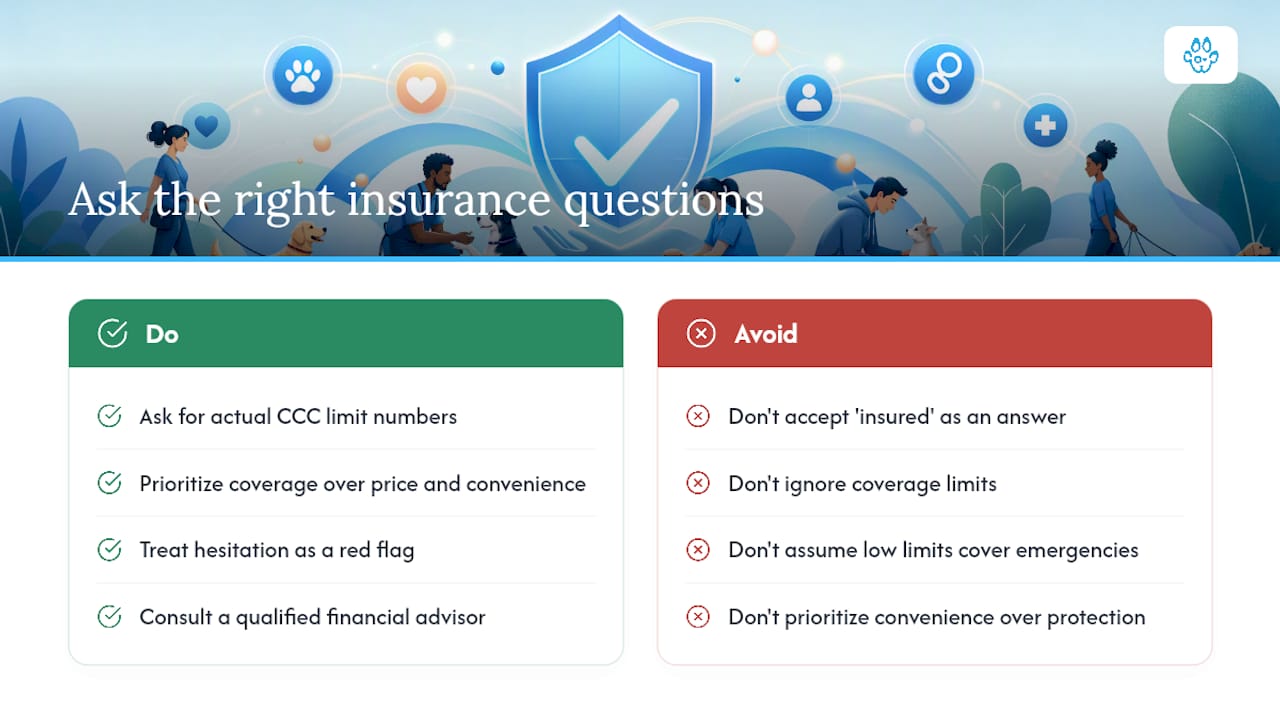
If you take one thing from this guide, make it this: ask for the actual numbers, not just the word "insured." A provider who hesitates when you ask about their CCC limit is telling you something, even if they do not say it out loud. Prioritize that conversation over price, over convenience, over anything else on your checklist.
This article is general information, not a substitute for advice from a licensed insurance professional or attorney. Consult a qualified professional about your own circumstances before acting on anything here.
Sources
- Pet sitting insurance: benefits, coverage, and costs, Fit Small Business
- Pet sitting insurance, Care.com Resources
- 10 benefits of hiring an insured pet sitter, PetWorks
- Pet sitters and dog walkers: why liability insurance is a must-have, Tillman Insurance Advisors
FAQ
Does pet insurance cover liability?
Pet insurance for owners typically covers your own pet's medical costs, not liability. Liability insurance for pet care providers is a separate policy that covers third-party injury, property damage, and legal defense.
What is the difference between bonded and insured?
Bonding protects against theft from a sitter, while insurance covers accidents, injuries, and property damage. Most reputable providers carry both, since they address different risks.
How much CCC coverage should a pet sitter have?
Industry experts generally recommend at least $25,000 in care, custody and control coverage, since emergency vet costs can easily exceed lower limits.
What should I ask to see before hiring a pet sitter?
Ask for a certificate of insurance (COI) showing the insurer's name, policy limits, effective dates, and whether CCC or animal bailee coverage is included.
Will my homeowner's insurance cover a pet sitter's mistake?
Usually not. Homeowner and renter policies commonly exclude business activities, which means a paid pet-sitting visit likely falls outside your coverage.


